

Most childcare centres don’t choose their supplier — they accumulate one. A director inherits an account from her predecessor, adds a supermarket run for the gaps, orders wipes from a website someone found, and three years later the centre is buying from five sources at five price points with no one accountable for any of it.
Choosing deliberately is worth an afternoon of any director’s time, because the supplier relationship touches everything: the budget line, the compliance folder, the daily question of whether the change room has gloves. The Perth market has plenty of options, from national marketplaces to local trade suppliers, and they are not interchangeable. This guide sets out the criteria that actually separate them — so a centre sourcing wholesale childcare supplies Perth wide can run a proper selection instead of drifting into another accumulation.
Criterion 1: Range Depth in Your Categories
The first filter is brutally simple: can one supplier cover your whole master list? A centre’s list spans nappies and baby wipes, gloves, zone-appropriate cleaning chemicals, soaps and sanitisers, paper hand towels and toilet rolls, tissues, bin liners and basic PPE. Generic cleaning wholesalers cover half of it; supermarkets cover it badly; many online sellers cover it inconsistently.
Test it directly — send your actual list and ask what they can supply. Every category they can’t cover is a second supplier you’ll be forced to keep, and fragmentation is exactly what you’re trying to end.
Criterion 2: Childcare Literacy, Not Just Stock
A supplier can hold the right products and still not understand your setting. Childcare literacy shows up in the conversation:
- Do they know which chemicals suit a nappy-change area versus a kitchen versus a play room?
- Can they supply Safety Data Sheets with every chemical, for your compliance folder?
- Do they stock genuinely childcare-specific lines — pull-on nappy pants, baby wipes in carton quantities, kids’ hand towels?
- Do they already supply other Perth centres, and can they speak to what a centre of your size typically consumes?
This matters more than it first appears. A supplier who understands centres becomes a low-key compliance asset — flagging the right product for the zone before an assessor flags the wrong one.
Criterion 3: The Commercial Model
How a supplier prices and transacts determines whether “wholesale” is real or just a word on the website.
What Good Looks Like
- Quote-based pricing on your whole list. They price your actual monthly consumption as a package, and the pricing improves as volume grows. A fixed public price list that never flexes is retail wearing a trade badge.
- Carton quantities as the default. Wipes, gloves and paper at centre volumes should never be priced by the single unit.
- A trade account. Repeat ordering by phone or form, consistent agreed pricing, clean monthly invoicing for the bookkeeper.
- No pressure toward pallet minimums. A good trade supplier meets a single centre where it is; minimums designed for distributors are a sign you’re in the wrong channel.
Run the numbers honestly: take one month of current spend across all your accumulated sources, and compare it against a single consolidated quote. The gap is usually decisive on its own.
Criterion 4: Delivery Reality
For a centre, delivery isn’t logistics trivia — it’s operational safety. The change room cannot run out of gloves because a warehouse in another state is slow. Interrogate this specifically when comparing any childcare cleaning supplies Perth source:
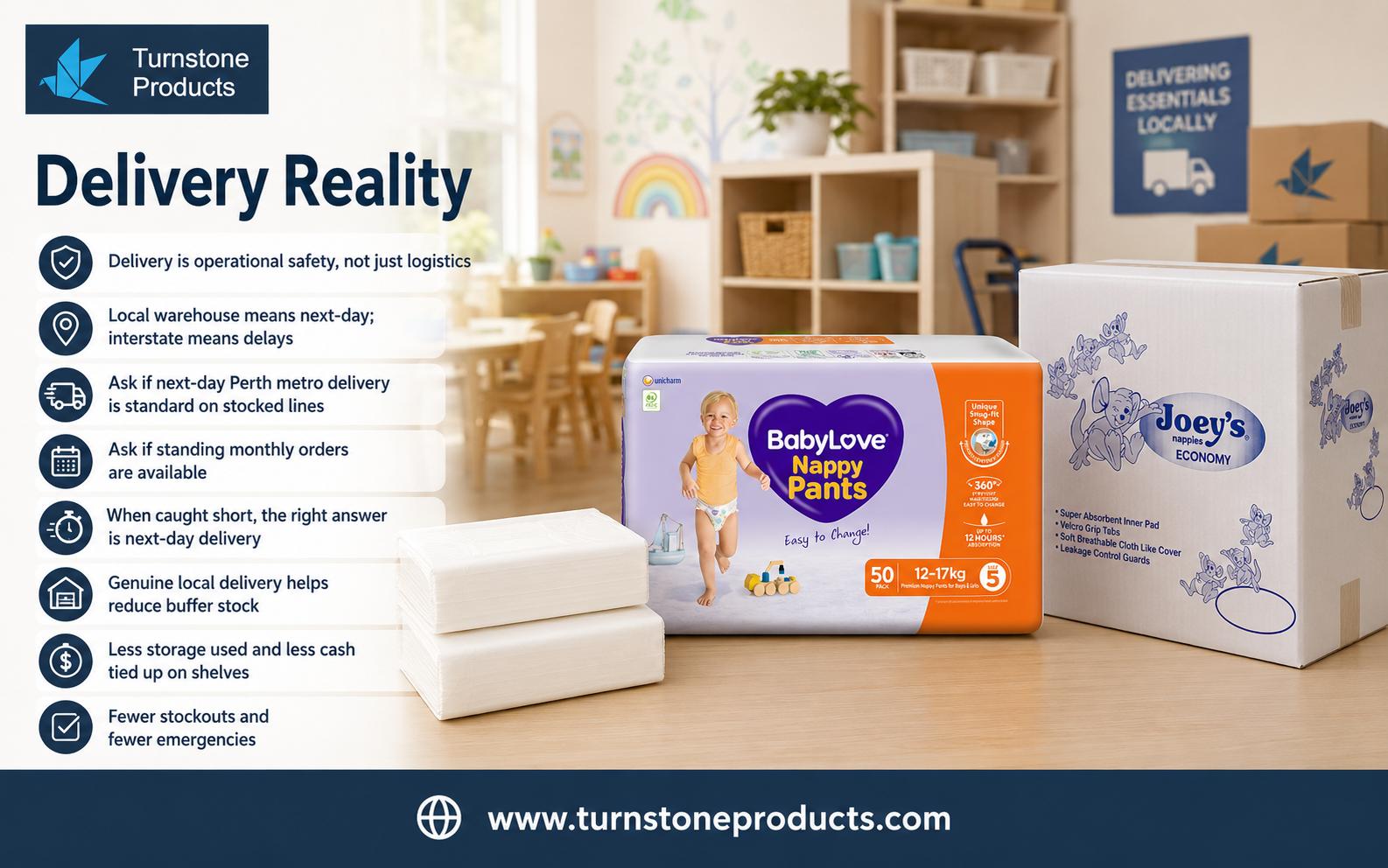
- Where is stock physically held? Local warehouse means next-day; interstate means hope.
- Is next-day Perth metro delivery standard on stocked lines, or an upsell?
- Will they run a standing order— a recurring monthly delivery matched to your consumption — so ordering becomes automatic?
- What happens when you’re caught short? The right answer is “call us, it’s on tomorrow’s run,” not a freight quote.
A supplier with genuine next-day local delivery changes your whole stocking posture: buffers shrink, storage frees up, cash stops sitting on shelves, and stockouts stop being emergencies.
Criterion 5: Accountability You Can Reach
Finally, the soft criterion that predicts everything else: when something goes wrong — a short delivery, a damaged carton, a product that isn’t right for the zone — who fixes it? With a national marketplace, the answer is a ticket queue. With a local trade supplier, it’s a person whose name you know, whose business lives in the same city as yours, and whose reputation among Perth centres depends on making it right. Over a multi-year relationship, that accountability is worth more than any single price difference.
The Shortlist Test
Put your two or three finalists through the same exercise: send the identical master list, ask for a full quote, ask the childcare-literacy questions, and confirm delivery terms. The right supplier tends to reveal themselves in how they handle the questions — engaged, specific and centre-aware, versus generic and price-only.
Why Choose Turnstone Products
Turnstone Products is a Perth-based B2B supplier that measures well against every criterion in this guide. Range depth: one supplier covers the full centre list — BabyLove and Joey nappies, Turnstone baby wipes, gloves, zone-appropriate cleaning chemicals, soaps, paper hand towels and toilet rolls, tissues, bin liners and PPE. Childcare literacy: centres are a core industry Turnstone services, with products matched to change rooms, kitchens and play areas. Commercial model: quote-based wholesale pricing by the carton, with trade accounts for repeat ordering. Delivery: stock held locally with next-day delivery across the Perth metro, and standing orders for centres that want supply on autopilot. And accountability: orders go by phone or quote form to a local team, not a ticket system. As a childcare essentials supplier Perth centres can actually reach, it’s the consolidated, deliberate choice this guide argues for.
Final Word
The difference between an accumulated supplier and a chosen one shows up every single month — in the budget, in the compliance folder, and in whether the cupboards are simply always stocked. Write your master list, apply the five criteria, test your shortlist with a real quote, and consolidate. It’s one afternoon of diligence for years of supply that just works.